


- Oct 3, 2018
- 3,704

The city was still dark as hundreds of police vehicles, armored trucks, and military assets drove through Istanbul. Black vans and unmarked sedans pulling out of the Vatan Avenue Police Headquarters compound at four-thirty in the morning, their headlights the only movement on roads that the Metropolitan Police had been quietly pre-clearing since midnight. The drivers had driven them three times in the preceding days, once in daylight, once at dusk, once at three in the morning when the city was as close to empty as it ever got.
The CkD had given them issues they spotted during their pre-clearance check. The narrow turn off Çırağan Caddesi, where a delivery vehicle could create a chokepoint, the service road behind the Four Seasons Sultanahmet that fed onto three different arterials, the underground garage approach at the Ritz-Carlton, where the geometry of the ramp created a natural observation blind that needed to be addressed.
The Istanbul Metropolitan Police Counter-Terrorism Branch had produced a sixty-page route security document in the week prior. It sat now on the desk of Deputy Chief Murat Avcı who had adopted some new measures to help keep any potential PKK or Wahhabist radicals from causing any issues.
Each delegation had been assigned a primary route and two alternates. The routes had been selected on four criteria, speed, minimisation of public exposure, minimisation of chokepoints, and the ability to seal them on short notice. The primary routes had been walked by the advance teams. The alternates had been driven. Every traffic camera along each corridor had been brought under the command of the Operations Centre at Vatan Avenue, which would have a live feed of all six routes simultaneously from the moment the first delegation departed the airport.
Avcı stood in the Operations Centre at four forty-five and looked at the board.
“Listen carefully,” he began. “This is not a special day. That is the first thing you need to understand. This is a working day. The only difference is that today, the margin for error is zero.”
“We have guests arriving. Heads of state, ministers, and people who will assume this city runs like a machine. Our job is to make sure they are correct. Our job is to leave them with the impression that they want us guarding them back home. ”
He gestured lightly toward the board. “We have a lot of people operating in our city. We have done our job, we have taken our preparations, and it is now time for us to execute it as we’ve trained. Nothing out there should surprise you. If it does, you correct it immediately.”
He paused, letting that settle. “Trust your preparation. It is the only reason we are standing here calmly instead of reacting blindly.”
A technician adjusted something at the console; a camera feed shifted. Avcı did not look. “You will remain disciplined on comms. No unnecessary traffic. No speculation. You report what you see, not what you think might be there. You verify what you can, and you move things up the food chain if you have a serious hunch.”
After a second he continued. “And you stay vigilant. Complacency does not come from laziness. It comes from familiarity. You have seen these streets too many times this week. That is when mistakes happen.”
He folded his hands behind his back. “Do your jobs. Trust each other. Keep your eyes open.”
He gave a small nod toward the operations floor. “Let’s get to work.”

The advance team arrived in two vans. Eight officers from the Diplomatic and Government Protection Command and four MİT technical personnel. The hotel's night manager met them in the lobby with the resigned cooperativeness of a man who had been briefed extensively and had nonetheless not fully appreciated what extensively meant until this moment.
The lobby was cleared of civilian staff except for the duty manager and two senior concierge personnel who had already been background-checked by the Foreign Ministry. The MİT technical team split immediately, two going to the basement level with their equipment cases, two going upstairs to begin a floor-by-floor sweep of the accommodation assigned to the Australian delegation.
The SIGINT sweep was completed after an hour or so. The two basement technicians worked from a rolling case that contained, among other things, a non-linear junction detector capable of locating electronic components whether powered or not, a radio frequency spectrum analyser running continuous passive monitoring across all relevant bands, and a thermal imaging unit for checking wall cavities and ceiling spaces.
They moved through the basement level in a pattern that covered every square metre, logging anomalies, a forgotten walkie-talkie in a maintenance closet, a wireless router that had not been on the hotel's network inventory, a junction box behind the laundry room that turned out to be exactly what it appeared to be but had nonetheless to be verified.
Upstairs, the accommodation sweep followed the same logic. Every room in the assigned block. Every ceiling tile. Every ventilation grille. The minibar power supply. The back of the television. The space behind the headboard. The technicians were not looking for anything specific, which is the only correct way to look for something you don't know is there.
While the MİT worked, the police team took the lobby. Two freestanding metal detector arches arrived in flat-packs from the van and were assembled by four officers in twenty minutes, one positioned at the main entrance, one at the corridor leading to the lifts serving the delegations' floors.
The hotel's own security director, a former Jandarma sergeant named Kemal Arslan who had been running hotel security for eleven years, watched the installation and made some suggestions about placement.
Arslan then led the police team to the two underground staff entrances, a service corridor connecting to the kitchen delivery bay, and a fire-exit stairwell that opened onto a narrow lane behind the building. Both would be staffed by the hotel's own security team from six AM onward. Arslan had pulled four additional private security contractors from a firm the hotel used for large events. They would not be armed but they would be present, in uniform, with radio contact to the police command post established in a room off the lobby.
Outside, two uniformed officers took position at the garage entrance by five-thirty. They were armed with a MP5 and holstered Yavuz 16 pistols, and they stood at the top of the ramp. A striped barrier arm was installed across the ramp. Every vehicle entering from this point forward would be checked against a pre-approved list, its boot inspected, its undercarriage examined with a mirror on a pole.
The first sweep of the Australian delegation's rooms was completed by six forty-five. The MİT team logged it clear, sealed the rooms, and departed for their next location.

The Four Season’s Bosphorus property was larger, more exposed, and hosted three delegations simultaneously, Sweden, Ukraine, and the Canadian. The MİT, the Metropolitan Police, and the Jandarma had appreciated the consolidation of the foreign delegation as it made securing the premises easier.
The Jandarma's Special Operations Company had been assigned to the external perimeter here. They arrived in three vehicles at five forty-five with twelve personnel in plainclothes and four in light tactical gear. They and established a cordon around the hotel's waterfront approach and its two street-facing entrances before any of the civilian city had woken sufficiently to notice.
The water side presented its own problem. The Four Seasons Bosphorus sat directly on the strait, its gardens running to a private waterfront, and the Coast Guard had assigned a patrol vessel to hold position offshore through the duration of the delegations' stay. The Jandarma team posted two personnel at the waterfront gate and one at each corner of the garden perimeter, with radio contact to the Coast Guard vessel maintained on a dedicated channel.
Inside, the MİT technical team was already working.
They had four personnel here rather than two, given the size of the property and the number of delegations. The sweep had begun at five AM using the same protocol as the Sultanahmet property, basement first, mechanical and electrical spaces, then the accommodation floors. The hotel had three wings and the delegations were distributed across two of them, which meant the sweep covered approximately eighty rooms before the team was satisfied.
In a room two floors above the Ukrainian delegation's assigned block, a room booked under a corporate reservation from a Latvian freight company, the RF scanner registered a passive monitoring device of a type consistent with a commercial-grade listening unit. The room had been booked six days earlier.
The MİT team leader called it in to the Operations Centre at six-twenty and had the room sealed within four minutes. A forensics technician was dispatched from Vatan Avenue. The corporate reservation was flagged for immediate investigation. The delegations' accommodation floors were swept a second time as a precautionary measure.
The second sweep came back clean. The duty manager, watching the second sweep team move through the corridor with their equipment, asked her assistant what they were looking for. The assistant told him it was routine. He did not look convinced, but he did not ask again.
The metal detector arches at the Bosphorus property were installed at the main lobby entrance and the corridor junction serving all three delegations' lifts. The hotel's own security director a, former private sector, had pre-positioned his additional contractors at the two underground service entrances before the police team arrived.
"Good." The officer looked at the underground entrance assignments. "Keep your people here. If anyone presents a credential you don't recognise, you call us before you make a decision. Don't decide on your own."
"Understood."
The garage was sealed by six-fifteen. Two Jandarma officers, armed, in tactical gear, stood at the top of the ramp with a vehicle manifest and a mirror pole. A third stood at the base of the ramp, inside the garage itself, with a line of sight to both the entrance and the door leading to the hotel's interior.

The Çırağan was the most complex property of the three, a nineteenth-century Ottoman palace with a facade running three hundred metres along the Bosphorus shore, multiple entrances, a history of hosting heads of state that meant its own security infrastructure was sophisticated.
The Joint Command Post for the Çırağan was established in a hotel conference room that had been cleared and dedicated to the security operation. By six AM it contained personnel from the Metropolitan Police Protective Security Department, the MİT liaison officer, a Jandarma platoon commander, and the hotel's own head of security, a former CkD officer named Cengiz Yıldız who had spent twelve years protecting the Presidential residence and had lateral-moved into private hospitality at forty-five with all of his instincts intact.
Yıldız had been preparing since the Russian accommodation was confirmed four days prior. He had repositioned his entire overnight security team, added eight contractors from a vetted firm, and personally walked every underground entrance, service corridor, and delivery access point in the building before the police arrived. When the Metropolitan Police advance team came through the door at six, Yıldız handed their commander a four-page briefing document he had prepared himself.
The commander read the first page and looked up. "This is thorough," he said.
"I used to do your job," Yıldız said with a smile. "Not exactly, but close enough."
The MİT SIGINT team went to work at six-fifteen. The sweep covered the Russian delegation's assigned floor, two floors of general accommodation above and below as a buffer zone, the basement level, the mechanical rooms, the kitchen, and the garden-facing ground floor service corridor. It was the most extensive sweep of the morning and it ran for two and a half hours.
Three anomalies this time, all minor, an unregistered Bluetooth transmitter in a vending machine in a staff corridor that turned out to be a private device belonging to a kitchen employee, a cellular repeater in the basement that the hotel had installed without updating their technical inventory; and a sealed maintenance hatch in the sub-basement that had not been on the building plans the MİT had been provided and which, when opened, revealed a utility crawlspace containing water pipes and nothing else.
All three were logged, verified, and cleared. The maintenance hatch was added to the building plans, which the team leader noted in the log with the dry satisfaction of someone who collects these small corrections.
The garage at the Çırağan was sealed with three officers, two at the entrance ramp, one at the interior door, and an additional barrier arm installed to supplement the existing hotel barrier. The steel bollards that the hotel used for event security were deployed along the street-facing drop-off area, reducing the vehicle approach lane to a single controlled channel.
Concrete barriers, arriving on a low-loader at six forty-five, were positioned at both ends of the street frontage, blocking any possibility of a high-speed vehicle approach to the main entrance.
The two underground staff entrances were assigned to Yıldız's contractor team with a Metropolitan Police officer on radio at each. Yıldız walked both positions himself at seven-thirty and adjusted the standing positions of both contractor pairs by a metre each, small corrections, based on sightline angles he had calculated from the access routes. "Stand here," he told one of the contractors, marking the position with his foot. "Not there. From there, you can't see the bend. From here you can." The contractor moved without argument.
The Iranian Crown Prince's delegation was accommodated at the Ritz-Carlton, which sat in the Şişli district, further from the Bosphorus waterfront than the other properties and with an urban geometry that meant the external perimeter was entirely street-facing, with no water exposure but with the additional complexity of being surrounded by active commercial and residential buildings on three sides.
The Metropolitan Police had eight uniformed officers to establish a visible presence on the four surrounding street corners from six-thirty onward. Two plainclothes officers were positioned in the café across the street and in the lobby of the office building diagonally opposite.
The MİT team arrived with their equipment at six-thirty and completed the sweep of the Crown Prince's assigned accommodation, the buffer floors, and the basement level in ninety minutes. The building was newer than the other properties and its technical infrastructure was documented more cleanly, fewer anomalies to investigate, the sweep faster for it. The team logged it clear at eight-fifteen.
The metal detector arch at the main lobby entrance was installed by seven. A second was positioned at the base of the lift bank serving the Crown Prince's floor. The hotel's security director, briefed extensively by the Foreign Ministry the previous day, had assigned his own personnel to both underground service entrances before the police team arrived. He had also, on his own initiative, asked the hotel's IT team to isolate the Wi-Fi network on the Crown Prince's floor from the hotel's general network and run it through a monitored router.
The garage entrance was handled by two Jandarma officers in light tactical gear, the vehicle manifest the same system as the other properties, the mirror pole and the undercarriage inspection the same procedure. A concrete barrier was positioned at the top of the approach ramp, forcing all vehicles to a full stop before being cleared forward.

Deputy Chief Avcı had been at the board since four-thirty. By eight AM he had received confirmation that all four properties were secured, all sweeps were complete or in final stage, all garage and underground entrances were staffed, and all metal detection infrastructure was in place and tested.
The route assignments sat on the board in four colours, one for each delegation's primary route from the airport. The Australian delegation's route ran through Sultanahmet along the coastal road, avoiding the Bazaar quarter's narrow streets entirely. The Swedish, Ukrainian, and Canadian routes from the Bosphorus property had been staggered to ensure the motorcades did not share corridor time. The Russian route from Çırağan was the shortest and had been assigned additional motorcycle outriders as a consequence of the delegation's own security posture and the size of its protective detail.
The Iranian Crown Prince's route from the Ritz-Carlton was the most complex, threading through Şişli and down toward the old city on a corridor that had required the pre-positioning of six traffic management officers at key intersections.Each alternate route had been pre-cleared and was being held on standby.
Avcı looked at the board and then at the clock. First arrivals at the airport in two hours and forty minutes.
"Route One," he said to the traffic coordinator on his left. "Confirm readiness."
"Confirmed."
"Route Two."
"Confirmed." He went through all six. All confirmed.
He drank a cup of tea from the desk behind him, drank it standing, and kept his eyes on the board. Outside the Operations Centre windows, Istanbul was waking up, the ordinary city going about its ordinary morning, the tea houses opening and the ferries beginning their crossings and the fishermen settling onto the Galata Bridge with their lines. None of them could see the preparations that had been made around them while they slept.

As spectators arrived at Atatürk Olympic Stadium and took their places along the illuminated Bosphorus viewing promenade, they found resting on their seats a deep crimson velvet pouch, hand-stitched, closed with a gold drawstring, bearing the Istanbul 2008 emblem on one face and the crescent and star on the reverse. The pouch was designed to resemble the fabric purses carried by Ottoman merchants along the Silk Road.
Inside the pouch spectators found a hand-painted ceramic tile coaster in Iznik blue-and-white pattern, a single-use crescent-shaped glow wand in red and gold (activated by bending), a small glass evil eye amulet (nazar boncuğu) on a gold cord, a folded programme booklet printed on parchment-effect paper with Ottoman-style calligraphic borders, a lapel pin in the shape of the Istanbul 2008 torch, a postcard reproduction of the Bosphorus painted by the Istanbul municipal artist Zeynel Akar, a small card with the Turkish and English text of the ceremony motto, and a Kodak CD-ROM containing the official Games guide.
The crescent glow wands were designed to be activated in unison at three moments during the ceremony: the Drumbeat of the Steppe, the Sufi Sema segment, and the lighting of the cauldron. Volunteers in each section were briefed to initiate the activation. The effect would hopefully be 91,000 crimson crescents lifted simultaneously in the darkened stadium.
The VIP box at Atatürk Olympic Stadium was formally constituted at 19:30, one hour before the ceremony's commencement at 20:08. The following dignitaries were confirmed in attendance:
Turkish Delegation:
The President of the Republic of Türkiye, accompanied by the First Lady. The Prime Minister of Türkiye and her husband. The Mayor of Istanbul. The President of the Istanbul 2008 Organising Committee (ISOOC). Former President Süleyman Demirel. The Minister of Youth and Sport. Several Turkish Olympic athletes.
Immediately flanking them:
To the left of President Abdullah Gül was Benjamin Valentine Sinclair, President of the United States. To the right of Prime Minister Çiller was Yulia Tymoshenko, President of Ukraine
Left Side (from the U.S. President outward, in descending order):
Franz von Habsburg, Archduke of Austria –
Dmitry Medvedev, Prime Minister of Russia –
Olympia Jean Snowe, United States Senator –
Madeleine Arbour, Governor General of Canada –
Senator Isabella Moretti, Minister of Tourism and Culture of Canada –
Katy Gallagher, Chief Minister of the Australian Capital Territory
Right Side (from the Iranian Crown Prince outward, in descending order):
Anūšīrawān Haxāmanišya, Crown Prince of Èran
Kristina Holmgren, Prime Minister of Sweden –
Dmitry Grigorenko, Deputy Prime Minister of Russia –
Oleksandr Turchynov, Head of the Presidential Administration of Ukraine –
Göran Hägglund, Secretary of Health and Social Affairs of Sweden –
Bahrām-e Čūbīn, Foreign Minister of Èran

Rogge arrived to a formal fanfare performed from the stadium's north tower by the Istanbul Military Tattoo Brass Ensemble, twelve musicians in full Ottoman ceremonial dress, their instruments fitted with crescent-tipped banners. He was accompanied into the VIP box by Naim Süleymanoğlu, the three-time Olympic weightlifting champion widely regarded as the greatest Turkish Olympian of the modern era, who served as official IOC escort for the evening.
The Prelude segment ran for sixty minutes before the formal ceremony, beginning at 19:08. It was hosted live from the northern stage of the stadium by TRT's senior sports presenter Ahmet Çakar, a veteran of four Olympic broadcasts, and by journalist and television personality Banu Güven, who hosted in both Turkish and English throughout.
The Prelude opened with a formal Welcome to Country performed by a Yörük elder from the Taurus Mountains, one of the oldest semi-nomadic Turkic pastoral communities still practicing traditional transhumance in Anatolia. He spoke in archaic Oghuz Turkish, the closest living approximation to the language of the first Anatolian Turks, while a translation scrolled in modern Turkish, English, and French on the stadium screens. He welcomed the nations of the world to Anatolian land, invoking the ancient Turkic sky god Tengri and then, in a deliberate theological bridge, the Islamic blessing of peace.
This was followed by a children's choir of 300 students from Istanbul's public schools performing the official Team Welcome Song. The Prelude also included a formal recognition of the Istanbul 2008 bid team by ISOOC President Hasan Arat, a video tribute to the 14,000 Games volunteers, a reading of the Olympic Truce resolution by the Turkish Ambassador to the GA, and three successive Mexican waves initiated from the southern stand by the volunteer corps. The stadium responded on the third attempt, the wave completing three full circuits before dissolving into sustained applause.“O peoples of distant lands,
O guests who have come from far horizons.
“Welcome to this land beneath the open sky, in the shadow of the mountains where our ancestors once walked, and where their memory still lives.
We are the Yörük, people of the road, of the wind, of the flock. In summer, we climb to the high pastures; in winter, we return to the valleys. Yet wherever we go, this land remains within us.
Long ago, the tracks of our forebears stretched from the great steppes of Central Asia
to the soil and stone of Anatolia.Since that day, this land has been both our home and our trust to protect.
The great sky above us, where Allah watches over us, has gathered you here beneath one horizon. Your tongues are different, your flags are many, yet today, you stand beneath the same sky.
As you set foot upon this ancient land, know that you enter not only a country, but a memory, a continuity, a living trust.
And now, as we bring these words to their close, we offer a blessing, bridging the sky of our ancestors and the faith of our hearts:
Peace be upon you. Peace be upon our messangers Adam, Abraham and Mohammed.
May your path be one of peace.
Welcome.”
The Prelude concluded with the saz player and folk poet Erdal Erzincan performing an improvised türkü, a traditional Anatolian ballad form composed specifically for the occasion, in which he addressed the athletes of the world directly in verse. The stadium fell quiet for it. Several journalists in the press box noted afterward that it was the most affecting moment of the entire evening.

At exactly 20:07, the stadium lights cut to black. The Bosphorus viewing promenade, visible through the open eastern end of the stadium, remained lit, the golden lanterns on the water catching the last of the August evening light.
A countdown was performed by the Istanbul State Symphony Orchestra, conducted by Gürer Aykal, with a composition by the Turkish composer Ahmed Adnan Saygun, a work commissioned specifically for the ceremony and scored for full orchestra, mehter percussion, and solo ney flute. The large screens displayed the countdown from 60 to 1 in Ottoman-style numerals overlaid on slow aerial footage of the Bosphorus at dusk. Beginning at the count of 23, archival footage from previous Games' opening ceremonies appeared, Athens, Sydney, Atlanta, Barcelona, Seoul, accompanied by the phrase, in white calligraphy, "Açılış Töreni." Opening Ceremony.
At 1, the ney fell silent. The mehter drums struck a single beat. Then silence.
From the darkness outside the stadium, carried across the warm August air from the hills above Üsküdar on the Asian shore, came the sound of a single davul drum. A pause. Then a second. Then a third. Within forty seconds, two thousand and eight davul drummers positioned in a line along the Asian shoreline from Üsküdar south to Kadıköy were beating in rolling unison a sound that witnesses described as physical, a pressure in the chest rather than simply a noise.
The rhythm was drawn from a reconstruction of Göktürk battle cadence. It accelerated over four minutes, the tempo climbing from a walking pace to a cavalry gallop before breaking into the drone of kopuz lutes and kaval flutes.
On the western face of the stadium's exterior, a projection spanning forty meters depicted the night sky of the Central Asian steppe, the Tengri sky, deep blue-black, scattered with the stars of the Oghuz constellation maps. Across it, a lone rider on horseback moved from left to right at a slow canter, carrying a lit torch. He reached the edge of the projection and disappeared. Twelve seconds later, the stadium interior exploded into light. A drone lighting show followed.
The segment concluded as the drumbeat slowed once more to a single pulse. On that final beat, the stadium floor, previously dark, was illuminated from beneath, revealing the blue and turquoise geometric pattern of a Seljuk tilework grid extending across the entire performance surface.
At 20:08 precisely, the time chosen for the resonance of the number eight across the cultures represented by the competing nations, the first vessel of the athlete fleet departed Üsküdar pier on the Asian shore and moved into the Strait. The Bosphorus had been closed to commercial traffic from 18:00; in its place, 91 decorated ceremonial vessels carried the competing delegations westward across the water toward the European shore.
The entire length of both the Asian and European shorelines visible from the Strait had been lined with 40,000 oil lanterns in the Ottoman Kandil tradition, the illuminations historically lit on nights of Islamic observance. The effect, visible from the vessels and from the stadium's open eastern end, was of two rivers of fire framing the dark water between them.


Australia, with Greece not participating in this Olympic Games, led the procession. It's delegation standing at the prow. All other nations followed in alphabetical order as rendered in Turkish. The host nation, Türkiye, sailed last.
As the fleet moved through the Strait, three performance stations, visible from the water and broadcast live on the stadium screens, presented continuous artistic sequences:
Station A — Kız Kulesi (Maiden's Tower)

From the lamp gallery of the Maiden's Tower, the Ottoman lighthouse standing alone in the middle of the southern Strait, the soprano Leyla Gencer performed an Ottoman ilahi composed in the 16th century for the court of Suleiman the Magnificent.
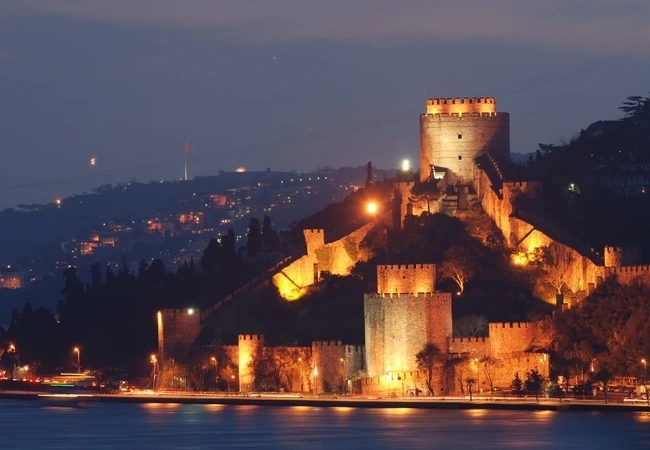
The vessels passed through from the Maiden’s Tower to the Rumeli Fortress. From the ramparts of the 15th-century fortress built by Mehmed II in preparation for the conquest of Constantinople, a two-hundred-piece mehter ensemble, the Ottoman Imperial military band, one of the oldest military music traditions in the world, performed in full ceremonial regalia. The composition was the Ceddin Deden march, re-orchestrated for the occasion by composer Fazıl Say to incorporate the Olympic fanfare motif. The sound echoed off the fortress walls and across the water.

The boats would then cruise towards Dolmabahçe Palace Waterfront. On the forecourt of the 19th-century Ottoman imperial palace on the European shore, the palace where Atatürk died in 1938, and where his clock was stopped at 9:05 and has not been changed since, five hundred Mevlevi sema dervishes in white robes and camel-hair hats performed the whirling ceremony on a platform constructed over the palace's ornamental gardens.
As the boats began to pass they would hear the Turkish Izmir March playing in commemoration of Atatürk.
The athlete fleet arrived at the Golden Horn and docked at the purpose-built floating stage at Galata at approximately 21:20. The Galata Tower was lit in crimson. Behind it, the minaret-and-dome silhouette of Hagia Sophia and the Sultan Ahmed Mosque framed the skyline. The Istanbul Opera performed the hymn "İstanbul İstanbul Olalı" from the roof of the Galata Tower as the last boats docked.
81 illuminated drones lifted from the tower roof, one per Turkish province, and formed the crescent and star of the Turkish flag over the Golden Horn. After holding the formation for one minute and forty seconds, the drones rearranged into the Olympic rings. Then into five Turkish calligraphic letters forming the word BARIŞ. Peace. The crowd along the promenade, which had swelled to an estimated 326,000 people, held the silence for a moment before the applause began.
Athletes were transferred by coach from the Golden Horn to the stadium, arriving through the tunnel entrances as the third artistic segment began on the performance floor. The Seljuk tilework grid remained lit from beneath the translucent stage surface, now augmented by slow-moving projections of camel caravans and sailing dhows.
Three thousand performers emerged from the tunnel entrances dressed as travellers, merchants, scholars, and navigators from across the medieval world, representing the civilisations that intersected Istanbul. From merchants of the Celestial Empire's Tang and Song dynasties in silk brocade to Persian mathematicians carrying astrolabes, Byzantine scribes with manuscripts, Arab navigators with charts, Venetian traders with counting frames, and Turkic cavalry riders on mechanical horses constructed from gilded frames and bicycle wheels.
Over it, a narrator, the actor Haluk Bilginer, recited selected passages from the Kutadgu Bilig, the 11th-century Turkic wisdom poem composed by Yusuf Has Hacib for the Karakhanid court. The poem was read first in modern Turkish, with English subtitles projected around the stadium bowl. The passage chosen concerned the obligations of a ruler to justice, and of a city to its guests.
The stadium plunged to complete darkness at 21:48. From the centre of the performance floor, a scale reconstruction of the Bab-ı Hümayun, the Imperial Gate of Topkapı Palace, rose hydraulically from beneath the stage surface. Lit in hammered gold light, its calligraphic inscription was visible to the upper tiers. It opened slowly. From behind it, one thousand performers entered in Ottoman ceremonial order: the Imperial Sipahi cavalry on horseback, the Janissary corps in their distinctive white felt caps, the Kapıkulu infantry guard, and the members of the Divan, the imperial council, in robes of crimson and sable.
The stadium lights softened to amber and rose. The cavalry withdrew. The Ottoman gate descended. The performance floor cleared.
From all twelve tunnel entrances simultaneously, five thousand performers flooded onto the floor in regional Anatolian folk costume, the accumulated textile tradition of a peninsula inhabited continuously for twelve thousand years. The performers represented forty distinct regional folk traditions from the Black Sea kemençe players and horon dancers from Trabzon and Rize; the zeybek tradition of the Aegean coast, its slow and deliberate movements derived from the posture of the eagle; the halay line dancers of the southeast; the hora of Thrace.
From the centre of the halka, the singer Sezen Aksu, in a plain white dress, without amplification for the first thirty seconds of her performance, began to sing a composition written for the ceremony by Zülfü Livaneli, with additional verse by the poet Murathan Mungan. The song was titled "Bu Topraklar" These Lands. It was sung first in Turkish.
From ancient stones where empires rose,
Through gilded halls and whispered prose,
We bring the echoes of our past,
A tale of courage meant to last.
O listen now, the land still speaks,
Through minaret and city streets.
From sultan’s court to modern day,
The heart of history finds its way.
These lands have seen both tear and flame,
Yet hope endures, a steady claim.
The rivers hum, the mountains sigh,
Inviting you to stand, to try.
Step forth, behold, and understand,
The stories carved by patient hands.
Where Ottoman splendor met tomorrow’s dawn,
A people’s spirit carries on.
O these lands, cradle of our yearning,
O these lands, where hearts keep burning.
Join the song, join the tale,
Through time and memory, we shall prevail.
Eighty-one young people carried the national flag of Türkiye into the stadium from the southern tunnel. They were accompanied in the procession by eighty-one Turkish Olympians who had carried the flag or stood on an Olympic podium in previous Games: weightlifters, wrestlers, judoka, sailors, and track athletes spanning the history of Turkish Olympic participation.
Together they carried the flag to the central flagpole at the stadium's geometric centre. The flag was raised in silence, a silence requested of the audience by the production team and observed.
The national anthem, İstiklal Marşı, the March of Independence, composed by Mehmed Akif Ersoy and set to music by Zeki Üngör in 1921, was then performed by the Istanbul State Choir of five hundred voices with full orchestral accompaniment under the baton of Gürer Aykal.

Then a silence emerged. ISOOC President Hasan Arat began his opening remarks.
“Tonight, we welcome the world’s greatest athletes to İstanbul, the heart of Türkiye. This city, straddling two continents, has been the witness to millennia of history, the crossroads of civilizations, the meeting place of ideas, faiths, and cultures. It tells a story of resilience, innovation, and progress.
It was here, under the guidance of Mustafa Kemal Atatürk, that a nation embraced the future, founded on principles of liberty, unity, and education. Atatürk believed that the path to progress is through the strength of its people and the pursuit of excellence, values that resonate in the spirit of these Games.
To the athletes of every competing nation: this stadium, this city, these streets, and this strait that you crossed, they are yours for the duration of these Games. You embody the ideals of courage, perseverance, and excellence. You remind us why we gather here: to celebrate human potential, to inspire generations, and to honor the bonds that unite us all.
May your efforts in these Games reflect not only your skill and dedication but also the shared dream of progress and peace that binds humanity together. And now, it is my honor to invite the President of the International Olympic Committee, to address us.
Then the IOC President John Coates began his address in a thick Australian accent. "Merhaba, Istanbul! Merhaba, Türkiye! The Olympic Games have come to a city that needs no introduction to the world, and yet continues to astonish it. Tonight we are gathered to open the Games of the Twenty-Ninth Olympiad, the Games of Istanbul 2008. Welcome to the athletes of many nations. Welcome to the officials, the coaches, the families, and the volunteers who make these Games possible. Our gratitude goes to the people and government of Türkiye, to the Province and city of Istanbul, to ISOOC for the excellence of its preparation, and to the 14,000 volunteers whose work we have witnessed tonight and will witness across the next sixteen days. Istanbul is a city of two continents.
The motto of these Games, Two Continents, One Flame, is not merely a description of this city's geography. It is a statement of what the Olympic movement believes that the world's differences are not obstacles to unity, but its very fabric. Sport does not erase those differences. It asks us to bring them to the same starting line and see what happens. That is the oldest idea in this movement, and it is still the best one. I now invite the President of the Republic of Türkiye to declare the Games of the Twenty-Ninth Olympiad open."
The President of Türkiye rose and delivered the formal declaration. The Olympic Games of Istanbul 2008 were thereby opened.

An immense white flag, its surface large enough to cover the entire performance floor, was carried over the heads of the athletes by two hundred volunteers working in relay, moving from the southern stand across the assembled delegations to the northern stage. On its surface, as it passed, images of past Olympic champions were projected, the footage sourced from the IOC archive and spanning every Games to date. When the flag reached the athletes, a Dove of Peace animation was projected onto its surface, followed by the Olympic rings.
The Olympic Flag was then carried around the arena by eight former Olympic champions representing the nations of the Games: Naim Süleymanoğlu of Türkiye, who carried it first; athletes from the Celestial Empire, the Honorable Indian Company, Australia, Russia, Sweden, Canada, and Britain. They handed the flag to the honour guard, who raised it as the Olympic Hymn was sung in Greek by the Istanbul Greek Orthodox Community Choir.
The Olympic Oaths were taken by the Turkish wrestler Rıza Kayaalp on behalf of the athletes, and by Turkish athletics official Fatma Yıldız on behalf of the officials.
The soprano Leyla Gencer, who had performed from the Maiden's Tower on the Bosphorus earlier in the evening, returned to the stadium stage and performed the ceremony's closing musical piece: "Alev" (Flame), an original composition written by Fazıl Say. It was accompanied by archival footage of the torch relay's journey through Turkiye the flame's passage from Olympia to Istanbul, played on the stadium screens. The relay had covered 8,000 kilometres across 81 days, visiting every Turkish province.
The stadium lights dimmed incrementally, drawing focus to the eastern platform where Natalia Nasaridze and Yaylagül Turan, Turkish gold medal olympic archers, had stood moments before. Both women approached a podium carrying a modern competition recurve bow a single arrow. The arrow's head was not a point but a socket, and as Turan and Nasaridze reached the marked position on the platform, one of the assistants approached with a torch from the Olympic Flame. The arrow's head ignited. The flame caught and held, bright against the stadium lights.
Turan accepted the bow without looking at the assistants, as did Nasaridze. They nocked the arrow as they drew their bows. The draw was slow and controlled. They both released . The cauldron sat 120 metres away,
The arrow moved so quickly it seemed to erase the space between her and the cauldron. There was no arc to observe, no dramatic trajectory—only the sensation of fire crossing darkness, of certainty made visible. The arrow struck the cauldron's central opening exactly, and the impact triggered the ignition mechanism.
Two flames erupted. The two columns of fire rose simultaneously, one from the eastern edge of the cauldron and one from the western, one facing Asia, one facing Europe. They burned separately for eight seconds. Then the cauldron's central mechanism engaged, drawing both columns inward, and they merged into a single column of fire above the bowl. Two continents. One flame. The crowd's response was loud and immediate and lasted without interruption for some eleven minutes.
The ceremony concluded at 23:41 with a coordinated fireworks display fired simultaneously from the stadium roof and from the rooftops of Hagia Sophia, the Sultan Ahmed Mosque, the Galata Tower, Topkapı Palace, and Rumeli Hisarı, five pillars of the Istanbul skyline.
BROADCAST & PRODUCTION NOTE

The ceremony was broadcast live by TRT in Türkiye and by rights-holding broadcasters in all 91 competing nations. The international host broadcast was produced by the Istanbul International Broadcast Centre in Maslak, with a secondary unit positioned on the Bosphorus relay vessel for the water procession.
The estimated global television audience for the opening ceremony was 1.2 billion viewers, making it the most-watched single broadcast event in Turkish broadcasting history. International press response was broadly positive, with particular attention paid to the Bosphorus procession, the Ottoman Century segment, and Sezen Aksu's performance of Bu Topraklar. Several commentators noted that the ceremony successfully distinguished itself from any prior model of Olympic opening ceremony, constituting instead something that could only have been made in, and about, Istanbul.
Production Director Ferzan Özpetek noted in his post-ceremony debrief that the original target duration had been three hours and fifteen minutes. The actual duration was three hours and thirty-three minutes, the additional time accounted for almost entirely by the crowd's response to the host nation's parade entry and to the cauldron lighting. No cuts were made to accommodate the overrun.


